
POWER.
TRANSFORMED.
Bladon microturbine gensets give your sites fewer service visits, lower running costs and the freedom to choose your fuel, with one service visit a year.
Updated
MTG12
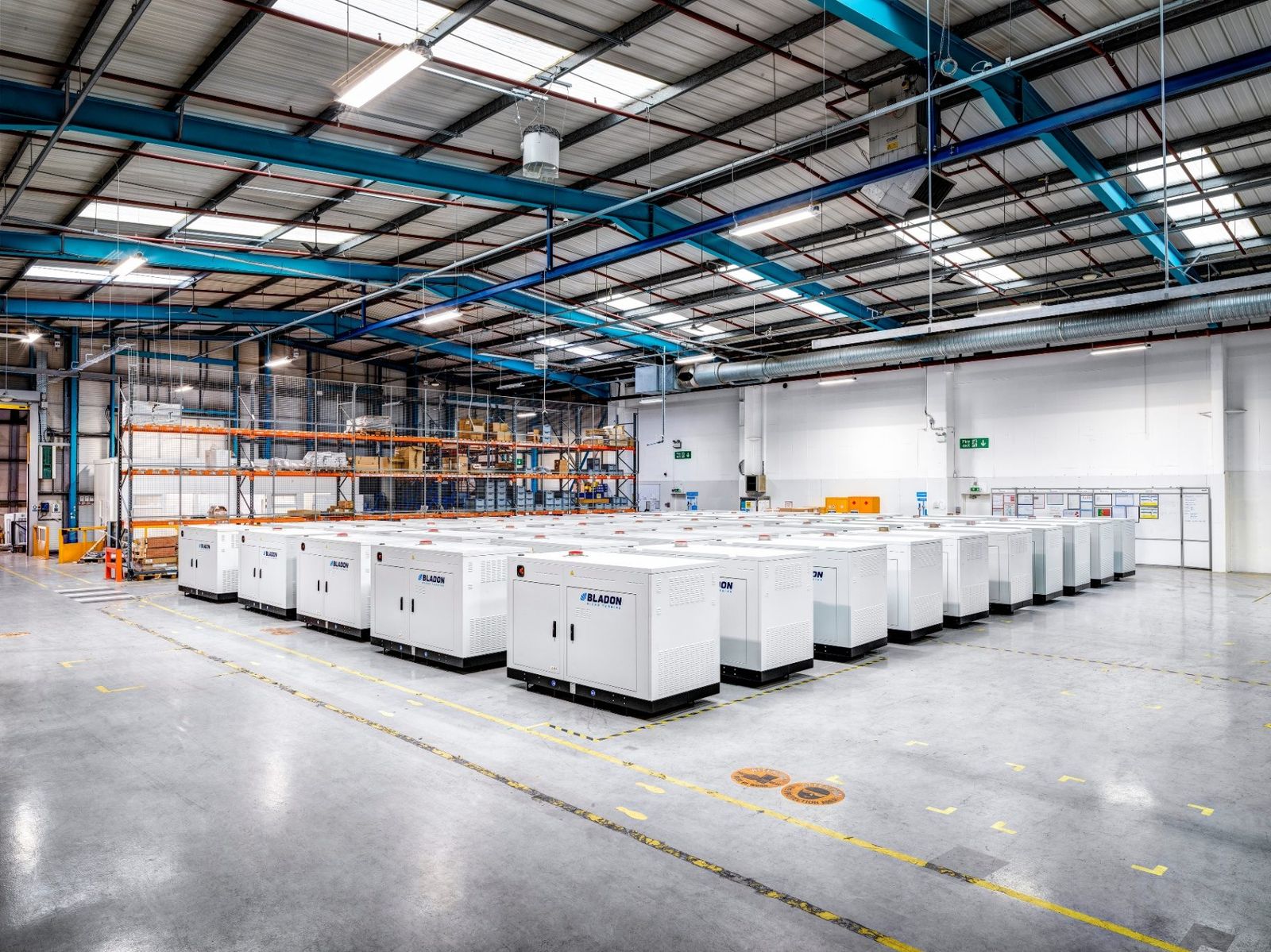
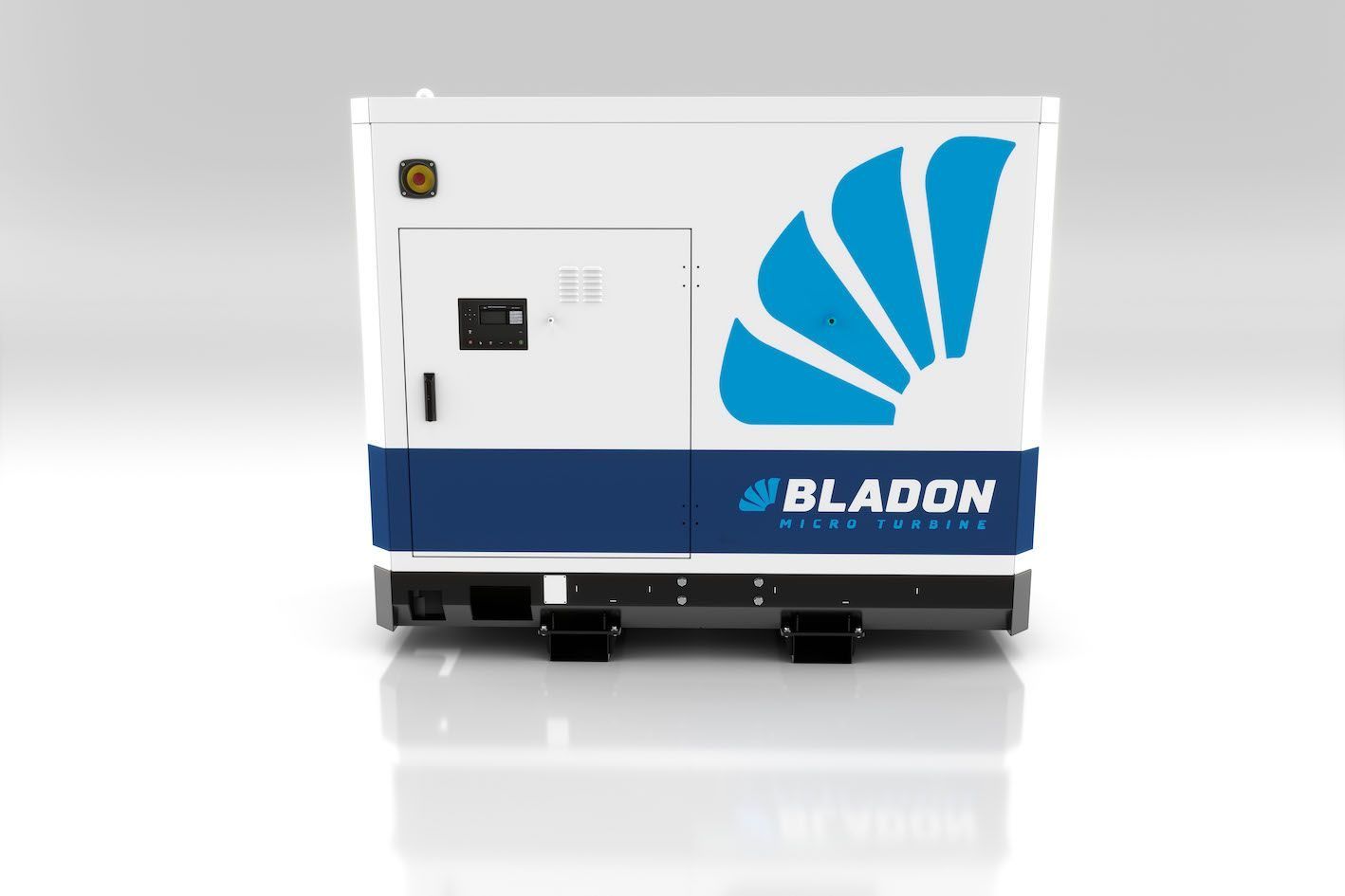
The MTG12 is our flagship 12 kVA multi-fuel microturbine genset, in production: available now. Designed for prime and standby power applications, it delivers exceptional reliability with oil-free air bearings, with no engine oil and no oil filters to change. The MTG12 is air cooled with no liquid coolant circuit; the MTP40 uses a sealed for life water glycol mix.
If the technology is new to you, what a microturbine is and how it works walks through the cycle before the specification.
Prime Power Output
Moving Part
Less Emissions
MTG12 standard; under 50 dB(A) with the optional Silent Pack
Prime Power Output
Three Phase
Standby Power
Short Circuit
MTP40
The MTP40 is our high-power 40 kVA three-phase microturbine genset, now available for pre-order. It suits larger installations that need reliable power from the same platform, with the same minimal maintenance requirements.
How microturbine power compares
Before choosing between the MTG12 and the MTP40, here is how the Bladon platform compares with the two alternatives operators usually weigh up: a diesel genset, and a solar and battery hybrid.
Compared for off-grid and bad-grid prime power at 10 to 40 kW.
| Criterion | Diesel genset | Solar and battery hybrid | Fuel cell | Bladon microturbine |
|---|---|---|---|---|
| Servicing & life | Disadvantage. Service every 250 to 500 run hours; 15,000 to 25,000 hour life | Disadvantage. Battery replacement every few years, plus servicing the diesel genset it still relies on | Disadvantage. Stack replacement required within the design life under continuous prime duty | Advantage. Annual service, 1 visit/yr; 45,000 hour life |
| Fuel flexibility | Disadvantage. Diesel only | Disadvantage. No fuel flexibility of its own; tied to whatever the backup genset burns | Disadvantage. Single fuel, high-purity hydrogen or methanol | Advantage. Multiple fuel types and blended fuels incl. HVO; H2 and gas in development |
| Emissions | Disadvantage. Particulates, NOx and soot | Matched. Clean while generating, and the backup genset it relies on still emits | Advantage. Zero emissions at point of use | Advantage. Exceeds EU Stage V equivalent; near-zero soot / PM |
| Noise & vibration | Disadvantage. 75 to 90 dB(A) at 1 m, with vibration | Matched. Silent on solar, and the backup genset it relies on is not | Advantage. Near silent | Advantage. Three times quieter than a diesel genset; minimal vibration |
| Operating cost | Disadvantage. Diesel only at the diesel price, frequent service visits, exposure to fuel theft | Disadvantage. High capital cost, sized for worst-case conditions, and still buying diesel for the backup | Disadvantage. Hydrogen supply and logistics cost at remote sites | Advantage. Up to 90% service cost saving and 30 to 50% fuel cost saving |
Bladon microturbine
- Servicing & life
- Advantage. Annual service, 1 visit/yr; 45,000 hour life
- Fuel flexibility
- Advantage. Multiple fuel types and blended fuels incl. HVO; H2 and gas in development
- Emissions
- Advantage. Exceeds EU Stage V equivalent; near-zero soot / PM
- Noise & vibration
- Advantage. Three times quieter than a diesel genset; minimal vibration
- Operating cost
- Advantage. Up to 90% service cost saving and 30 to 50% fuel cost saving
Fuel cell
- Servicing & life
- Disadvantage. Stack replacement required within the design life under continuous prime duty
- Fuel flexibility
- Disadvantage. Single fuel, high-purity hydrogen or methanol
- Emissions
- Advantage. Zero emissions at point of use
- Noise & vibration
- Advantage. Near silent
- Operating cost
- Disadvantage. Hydrogen supply and logistics cost at remote sites
Solar and battery hybrid
- Servicing & life
- Disadvantage. Battery replacement every few years, plus servicing the diesel genset it still relies on
- Fuel flexibility
- Disadvantage. No fuel flexibility of its own; tied to whatever the backup genset burns
- Emissions
- Matched. Clean while generating, and the backup genset it relies on still emits
- Noise & vibration
- Matched. Silent on solar, and the backup genset it relies on is not
- Operating cost
- Disadvantage. High capital cost, sized for worst-case conditions, and still buying diesel for the backup
Diesel genset
- Servicing & life
- Disadvantage. Service every 250 to 500 run hours; 15,000 to 25,000 hour life
- Fuel flexibility
- Disadvantage. Diesel only
- Emissions
- Disadvantage. Particulates, NOx and soot
- Noise & vibration
- Disadvantage. 75 to 90 dB(A) at 1 m, with vibration
- Operating cost
- Disadvantage. Diesel only at the diesel price, frequent service visits, exposure to fuel theft
- Advantage
- Matched
- Disadvantage
MTG12 vs MTP40
Two units, one platform. Same fuels, same service model, same design life. The difference is output, phase and the size of site each one is built for.
| Specification | MTG12 | MTP40 |
|---|---|---|
| Power output | 12 kVA / 12 kW prime and standby | 40 kVA / 32 kW prime, 44 kVA / 35.2 kW standby |
| Phase | Single phase | Three phase |
| Voltage | 230 Vac single phase 50/60 Hz | 380 to 415 V three phase 50/60 Hz |
| Cooling | Air cooled | Sealed for life water glycol mix |
| Rated condition | 15°C (ISO standard reference conditions) | 25°C |
| Engine speed | 65,000 to 135,000 RPM | 50,000 to 120,000 RPM |
| Power factor | 1.0 | 0.8 |
| Fuel consumption | 2.2 / 3.2 / 4.3 / 5.6 L/hr at 25 / 50 / 75 / 100% load | 3.40 / 5.47 / 7.47 / 9.90 L/hr at 25 / 50 / 75 / 100% load |
| Dimensions | 2.1 x 1.01 x 1.4 m | 2.25 x 1.01 x 2.00 m |
| Altitude | 0 to 2,000 m | 0 to 2,500 m |
| Weight | Approx. 857 kg dry | 1,400 kg with coolant, no fuel |
| Short circuit capability | N/A | 200% short circuit capability for 10 s |
| Noise | 60 dB(A) (under 50 dB(A) with the optional Silent Pack)Both figures are sound pressure in free-field conditions. The MTP40 figures are a design target, not yet verified by test. | 60 dB(A) (design target, not yet verified by test)Both figures are sound pressure in free-field conditions. The MTP40 figures are a design target, not yet verified by test. |
| Ambient temperature | -20°C to +50°COutput de-rates for altitude and for temperature above ISO 8528 standard reference conditions. Cold Pack and Hot Pack kits are available for the ends of the range. | -20°C to +45°COutput de-rates for altitude and for temperature above ISO 8528 standard reference conditions. Cold Pack and Hot Pack kits are available for the ends of the range. |
| Service interval | One service visit per year | One service visit per year |
| Design life | 45,000 hours | 45,000 hours |
| Fuels | Diesel, kerosene, paraffin, HVO, FAME biofuel | Diesel, kerosene, paraffin, HVO, FAME biofuel |
| Availability | In production: available now | Now available for pre-order |
Which one do I need?
- Up to 12 kW continuous, single phase: the MTG12. Typical of a single-tenant telecom tower, a monitoring station, a rural cabinet or a forward operating position.
- 12 kW to 32 kW continuous, or any three-phase load: the MTP40. Typical of multi-tenant tower sites, larger field camps, production pads and commercial or industrial loads.
- Motor-starting duty: the MTP40, for its 200% short circuit capability and 44 kVA standby headroom.
Compatible Fuels
Both the MTG12 and MTP40 run on a range of liquid fuels available today, including blends of these in any ratio. Biogas, LPG, natural gas, flare gas, hydrogen, ethanol and bioethanol are in development.